
Published on August 05, 2025. Article written by . Last updated: November 02, 2025
Financial reporting can't be an afterthought if you're serious about running a successful business. It's more than just crunching numbers or checking off a compliance box. Accurate, timely, and comprehensive data provide the clearest picture of your company's health. Your growth and credibility depend on it. Without it, you're essentially guessing—a risk no business can afford to take.
Whether managing a small business or scaling up a growing enterprise, your financial reports are your GPS. They guide your decisions, help you avoid costly missteps, and give you confidence while navigating complex challenges.
Below, we'll tell you the top six hidden powers of financial reporting, common mistakes to avoid, and how CPA firms offering financial services can help you with this crucial business role.
1. It Helps You Understand Your Financial Health
Imagine trying to run a marathon without ever checking your pace or hydration. Sooner or later, you'd hit a wall.
The same happens when you try to run a business without understanding your financial position. Financial reporting shows key performance indicators, such as profit margins, revenue growth, expenses, and cash flow.
Quickly spot trends and take corrective action based on your income statements, balance sheets, and cash flow reports. You might be surprised to find your expenses creeping up faster than sales or tightening cash flow despite your healthy-looking revenue.
Lack of data leaves you guessing, or worse, reacting too late. Financial reports give you a foundation to act, not just react.
2. It Produces Informed Strategic Decisions
Every business owner faces critical choices: when to hire, when to expand, when to invest, and when to cut back. These decisions can either drive your business forward or derail your progress.
Don't rely on gut instinct or wishful thinking. Solid financial reporting helps form the basis of all your decisions. Make wiser decisions backed by data.
Let's say you're considering opening a second location. Before making that leap, your financial reports can tell you whether your current margins can support the expansion. You'll know if you have enough cash reserves or need to secure funding. You can even run projections based on different scenarios to plan for best- and worst-case outcomes. You're taking a shot in the dark without that data.
3. It Keeps You Compliant and Audit-Ready
No one likes dealing with regulatory paperwork, but compliance is a non-negotiable part of running a business. Accurate financial reporting ensures you're always prepared, whether filing taxes, submitting financials to lenders, or meeting industry-specific regulations.
When tax season rolls around, having organized financial reports means fewer headaches and less scrambling to find missing data. Your reports will demonstrate transparency and professionalism if your business ever faces an audit.
Additionally, staying compliant protects you from legal penalties.
4. It Builds Trust With Investors and Lenders
Organized and accurate financial reports build trust with external parties, like banks, vendors, and investors.
Prospective investors and lenders will evaluate your financial reports when you seek to raise capital or secure a loan. They want to see not just potential but proof. Clean, detailed, and consistent financial reports show that you take your business seriously and can manage funds responsibly.
Investors need to understand how your business generates revenue, what your costs look like, and how profitable you are. Lenders want to know that you can repay a loan. If your reporting is sloppy or inconsistent, it raises red flags. You're far more likely to get the funding you need (and on favorable terms) with orderly books and accurate projections.
5. It Helps You Set and Measure Goals
Goal setting is part of every business journey. However, goals mean little without a way to measure progress. Financial reporting gives you that measuring stick. Whether you want to increase revenue by 20%, cut overhead costs by 10%, or improve your net profit margin, your financial statements tell you exactly where you stand.
Each new report is a check-in on your progress. You can compare actual results with your budget, spot areas where you're falling short, and adjust to get back on track. Over time, this process creates a culture of accountability and continuous improvement, essential for long-term growth.
6. It Creates Internal Transparency
Financial transparency within your organization is always important, whether or not you work with external investors or lenders. When your team understands the business's performance, they can align their efforts with broader goals and make smarter decisions in their roles.
For example, say you emphasize reduced customer acquisition costs to your sales team. The team can better target their efforts and explore more efficient lead-generation strategies with access to financial insights.
Meanwhile, your operations manager might spot ways to reduce waste or negotiate better vendor terms. Informed employees make empowered employees. And it all starts with sharing meaningful data.
Avoid These Common Financial Reporting Mistakes
Understanding the importance of financial reporting is just the first step. There's a lot more to understand to avoid costly mistakes.
One of the most common trip-ups is inconsistent reporting schedules. If you only review your numbers sporadically or during a crisis, you lose the ability to act proactively.
Another mistake is overcomplicating your reports. Details matter, but too much complexity can make it hard to draw actionable insights. Stick to clear, concise reporting that highlights the most important metrics.
Finally, failing to reconcile data across systems, like your sales platform, accounting software, and bank statements, can lead to errors and misinterpretations.
To avoid common financial reporting pitfalls:
- Create a routine
- Review your financials monthly
- Keep accurate and orderly records
- Use accounting tools and advisors for help
Your discipline will pay off in performance and peace of mind.
Partner With a CPA
Accurate and timely bookkeeping and accounting duties can be challenging, especially if you don't have an accounting background.
No worries. You don't have to be a CPA to run a successful business. Professional business accountancy services exist to help companies succeed. An experienced accountant can help you handle any money-related task for your business, from advising and utilizing accounting software to record-keeping and financial reporting.
Financial Reporting Fuels Wiser Decisions
Financial reporting is one of the most valuable tools for running a smart, sustainable business. It provides clarity, builds credibility, and gives you the insight for strategic decisions. Whether you're just starting out or managing an established company, investing in your reporting processes will pay dividends in control, confidence, and growth.
When you commit to regular, accurate, and insightful financial reporting, you take a major step toward not just running your business, but running it better. It's how you ensure the numbers work in your favor.
Video
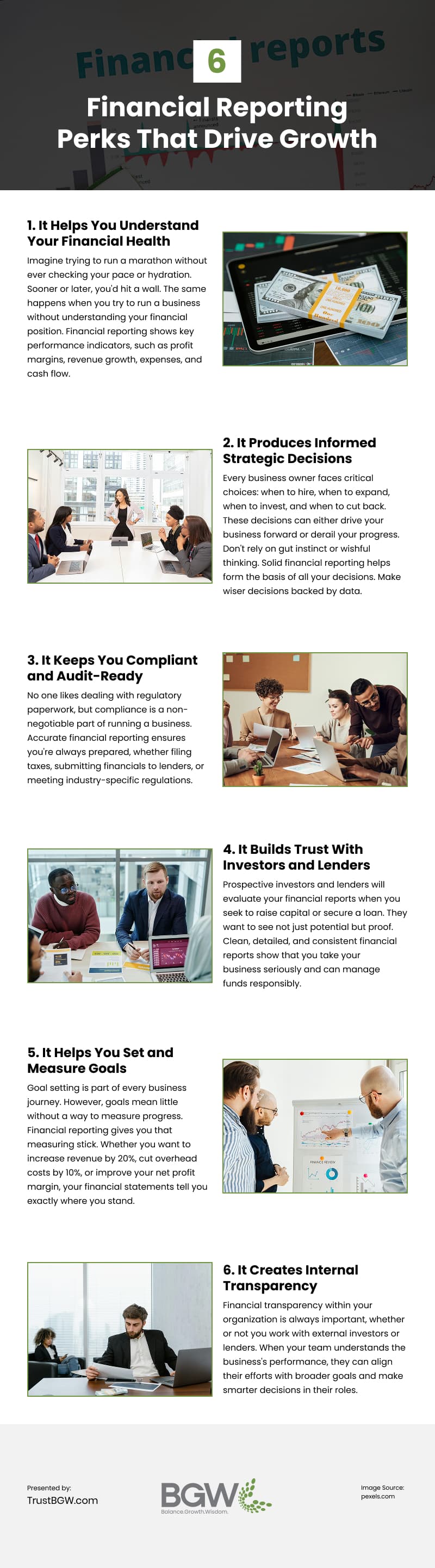
Infographic
Financial reporting is a strategic tool that drives growth, enhances credibility, and keeps your business on course rather than merely being a compliance task. Explore this infographic to discover the advantages of financial reporting that foster growth.