
Published on January 22, 2026. Article written by . Last updated: January 27, 2026
As a member of an audit committee, you're responsible for shaping your organization's financial integrity and strategic direction. It's your responsibility to identify risks before they become a crisis and recognize opportunities that can drive better outcomes. To do that well, you must constantly reevaluate your priorities in a landscape where risk profiles and growth strategies are continually shifting.
Here are the top challenges and opportunities during a CPA audit, along with the steps you can take as a member of the audit committee to approach the process with confidence. The focus will be on proactive risk identification and seizing strategic opportunities during the audit process.
Your Role as an Audit Committee Member
As an audit committee member, you serve as a safeguard between management and stakeholders, ensuring transparency and promoting ethical financial behavior. You're also a bridge between external auditors and internal teams, which puts you in a powerful position to challenge assumptions and demand clarity.
Your impact extends beyond compliance. In addition to traditional oversight, audit committees are now expected to drive risk-aware performance, tracking emerging risks like cybersecurity, ESG, and supply chain issues. With that broader role in mind, here are the top risks to keep on your radar:
Top Risks to Stay Ahead Of
1. Financial Reporting and Internal Controls
Inaccurate financial reporting can lead to legal exposure and reputational damage. Assess the strength of internal controls and the adaptability of the systems you're auditing. Are forecasts realistic? Are revenue recognition practices consistent with GAAP? Regularly revisit these areas for accurate reporting.
2. Cybersecurity and Data Privacy
Cyber threats have outpaced traditional IT controls. Ransomware, data breaches, or system failures can cause more than just downtime; they can also lead to significant financial losses, damaged trust, and regulatory scrutiny.
To stay ahead of such a risk, your audit committee should insist on regular updates from leadership and confirm whether the organization's cybersecurity risk is assessed in alignment with the broader enterprise risk framework.
3. Regulatory Compliance
Staying ahead of compliance obligations is becoming increasingly challenging, particularly if your organization operates across multiple jurisdictions or industries. Tax laws, ESG disclosures, data protection regulations, and anti-corruption policies are all in play. During your auditing process, continually assess if your organization is prepared to respond to a regulatory audit or investigation.
Strategic Opportunities You Can Leverage
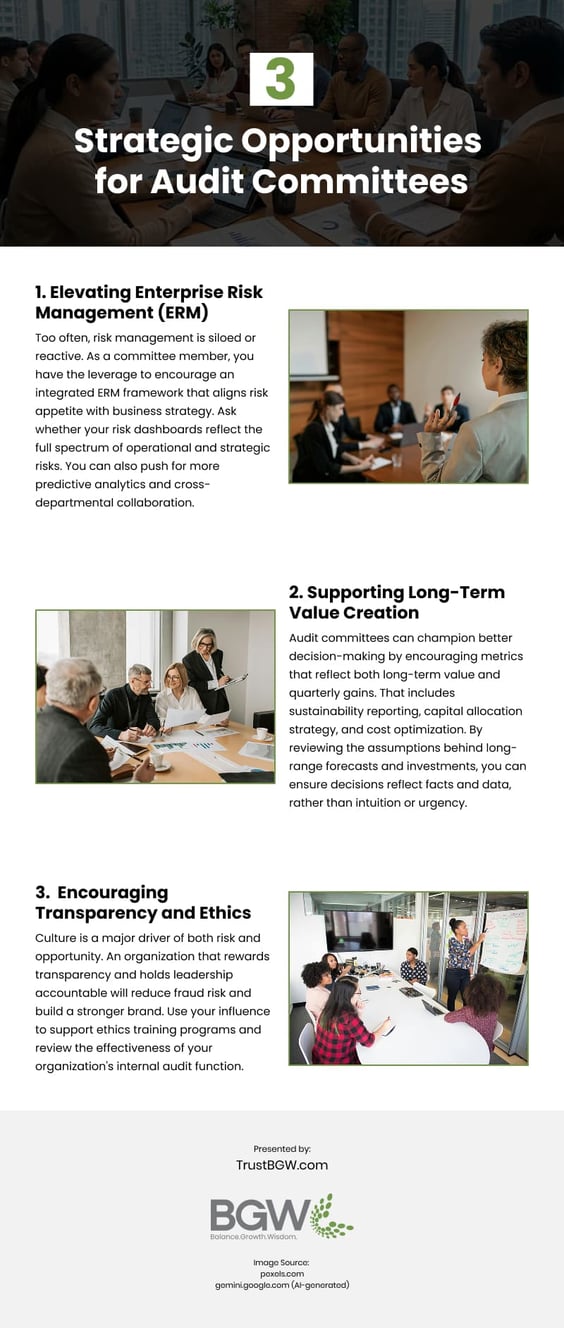
1. Elevating Enterprise Risk Management (ERM)
Too often, risk management is siloed or reactive. As a committee member, you have the leverage to encourage an integrated ERM framework that aligns risk appetite with business strategy. Ask whether your risk dashboards reflect the full spectrum of operational and strategic risks. You can also push for more predictive analytics and cross-departmental collaboration.
2. Supporting Long-Term Value Creation
Audit committees can champion better decision-making by encouraging metrics that reflect both long-term value and quarterly gains. That includes sustainability reporting, capital allocation strategy, and cost optimization. By reviewing the assumptions behind long-range forecasts and investments, you can ensure decisions reflect facts and data, rather than intuition or urgency.
3. Encouraging Transparency and Ethics
Culture is a major driver of both risk and opportunity. An organization that rewards transparency and holds leadership accountable will reduce fraud risk and build a stronger brand. Use your influence to support ethics training programs and review the effectiveness of your organization's internal audit function.
How to Stay Aligned with Evolving Expectations
You can't afford to take a static approach to audit committee work. External expectations are growing, and your stakeholders want evidence that your governance is forward-thinking, not just reactive. Here are three ways you can stay sharp:
- Schedule more frequent deep-dive sessions on key risk areas, such as cyber or ESG.
- Engage with external experts to assess complex areas, such as geopolitical risk or emerging regulations.
- Benchmark your committee practices against peer organizations or established governance standards.
Keep in mind, even the most experienced committees need to challenge their own assumptions. Bringing in outside perspectives, conducting self-assessments, and regularly updating your charter are all signals of a strong and proactive committee.
The Importance of Communication and Trust
Ultimately, the effectiveness of your audit committee depends on your communication with executive leadership and internal teams. You should foster an environment where open dialogue is both accepted and encouraged. If you sense hesitation from management in disclosing bad news or admitting uncertainty, that's a red flag worth exploring.
When you ask tough questions and engage in meaningful conversations, you reduce the chance of unpleasant surprises. It also helps ensure that key risks are understood across the board and not just buried in spreadsheets or quarterly reports.
Approach Audits with Confidence
Your audit committee role carries immense responsibility, but it also presents an opportunity to elevate your organization's performance and resilience. By staying focused on both risk mitigation and value creation, you position yourself as a strategic partner.
The key is to keep evolving. New technologies, regulatory changes, and global uncertainties will continue to shift the risk landscape. But with a strong understanding of what matters—sound financial planning and long-term thinking—you can guide your organization through uncertainty and into opportunity.
Video
Infographic
As an audit committee member, you safeguard financial integrity and support sustainable growth. Succeeding in this role means continually reassessing priorities as risks and strategies evolve. Explore this infographic to identify key strategic opportunities you can leverage.