
Published on March 19, 2026. Article written by .
A project can look profitable on paper and still drain cash in the field. With change orders, delayed payments, and rising material costs, margins can erode long before the job wraps up. Choosing the right construction accounting firm can make a meaningful difference in how well you stay compliant and plan for growth. The right partner helps you see the full financial picture of your projects (not just last month's numbers).
Construction finances don't fit neatly into standard accounting models. When you work with a construction accounting firm that supports how your business uniquely operates, you can plan ahead with better insight into costs, revenue timing, and risk.
Look for Industry-Specific Experience
Construction accounting is different from general business accounting. If your accountant doesn't understand industry specifics like job costing, retainage, or work-in-progress reporting, you'll waste time explaining your business operations instead of getting useful guidance.
An experienced construction accounting firm understands how delays, change orders, and material price swings affect your financials. They know how to track profitability by project, not just across the company as a whole. It makes it easier to identify underperforming jobs early and make adjustments before losses accumulate.
Industry experience also plays a crucial role in compliance. Construction businesses frequently encounter distinct tax rules, labor regulations, and reporting requirements. An accountant familiar with these areas helps you avoid costly mistakes that might occur when applying generic accounting practices to a specialized industry.
Evaluate Their Approach to Job Costing and Reporting
Accurate job costing sits at the center of healthy construction finances. If you can't see where your projects make or lose money, you can't bid accurately or grow sustainably. A strong accounting firm helps you set up systems that track labor and equipment at the job level.
Look for a firm that provides clear, easy-to-understand reports rather than overwhelming spreadsheets. These reports should detail each project's performance, rather than provide a generic review. Detailed and organized insights help you have more productive conversations with lenders and partners. That opens the doors for larger projects or better financing terms.
Understand How They Support Cash Flow Management
In construction, profitability doesn't always translate to steady cash flow. Long billing cycles, delayed payments, and retainage require careful planning. The right accounting firm helps you proactively manage timing gaps, keeping operations steady even when payments lag.
Your accountant should help you forecast cash flow based on current projects and upcoming expenses. You'll be able to plan payroll and material purchases accurately without guesswork. It also makes it easier to decide when to take on new work or when to slow down to maintain a stable financial position.
A construction-focused accountant also understands how billing methods affect cash flow. Whether you use progress billing or fixed-price contracts, they can help you structure invoices and payment schedules that support stability rather than create stress.
Assess Communication and Accessibility
Accounting relationships function most effectively with clear and timely communication. You want a firm that explains financial information in plain language and responds quickly to your questions. If you feel confused or ignored, the relationship can quickly become frustrating.
Pay attention to how the firm communicates during early conversations. Do they ask thoughtful questions about your business, or do they rely on generic explanations? A good construction accounting firm takes time to understand your individual challenges.
You should also consider accessibility. Construction doesn't always follow a nine-to-five schedule. Financial issues can arise unexpectedly. Knowing who your point of contact is and how quickly you can get answers helps you stay focused on running projects instead of chasing information.
Consider Their Role in Long-Term Planning
As your company grows, you may face decisions around hiring, equipment purchases, expansion into new markets, or ownership transitions.
A firm that understands your business over time can help you make informed decisions with financial clarity. They can model different scenarios, show you how choices affect profitability, and help you avoid overextending resources. This guidance becomes especially valuable as your project sizes increase and financial stakes grow.
You benefit most when your accountant serves as an advisor, not just a recordkeeper. That means offering insights and helping you connect today's numbers with tomorrow's goals.
Ask the Right Questions Before You Decide
Before choosing a construction accounting firm, consider asking questions that reveal how they work. Discuss things like:
- Their experience working with construction companies similar in size and scope to yours
- How they handle job costing, work-in-progress reporting, and project profitability
- What their communication process looks like throughout the year
The answers you receive should feel specific and thoughtful, not rehearsed. When a firm can explain how it supports construction businesses in practical terms, it's a sign it understands your industry well.
It's Time to Invest in the Right Construction Accounting Firm
Choosing the right construction accounting firm is about finding a partner who understands your industry and supports both your current operations and future goals. When your accountant sees your business the way you do, financial management becomes a tool for growth rather than a source of frustration.
By focusing on experience, reporting quality, cash flow support, and long-term guidance, you position yourself to run projects smoothly and build a more resilient construction business.
Video
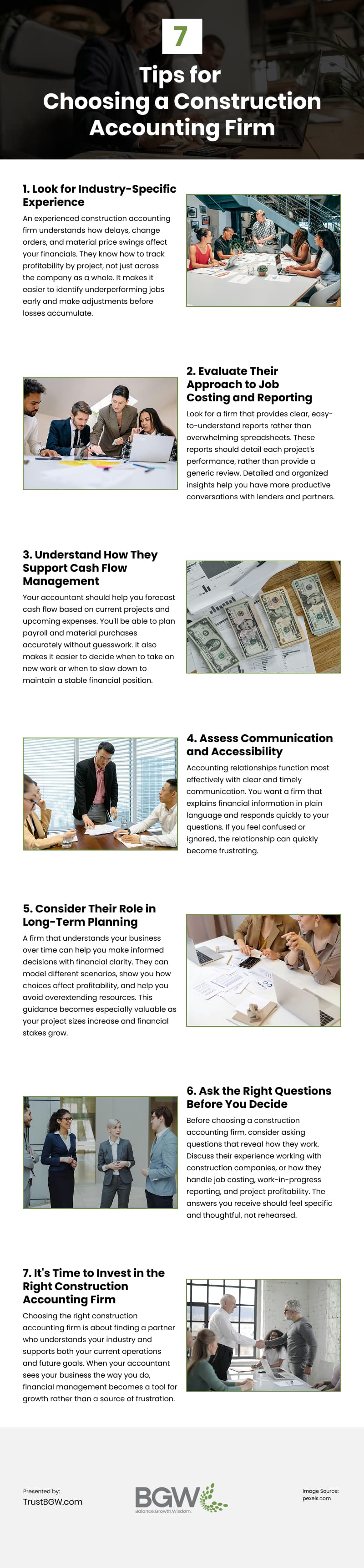
Infographic
Construction finance is complex and rarely fits traditional accounting models, making it crucial to partner with a firm that understands the industry's unique demands. This infographic shares key tips to help you choose the right construction accounting firm.